Insight
Rapid-Response Videos That Don't Feel Rushed
By Ryan Sauvé · June 1, 2026 · 10 min read
The real threat to rapid-turnaround videos isn't speed. It's friction.
Listen to this article
Written and read by Ryan Sauvé.
Rapid-Response Videos That Don't Feel Rushed
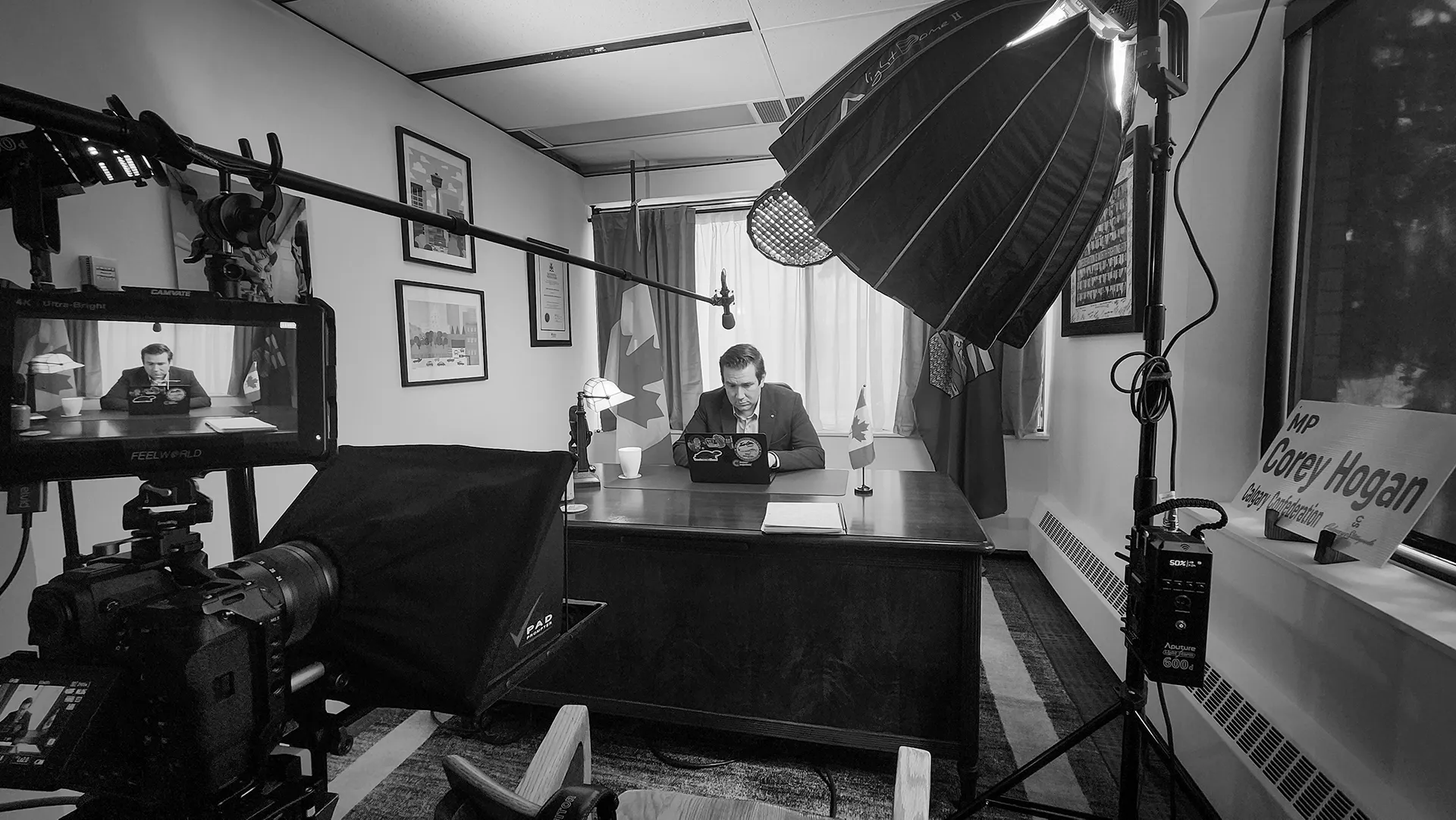
For most of 2026, the news cycle in this province has centred on one question: should Alberta stay in Canada? And while polls consistently show that most Albertans would choose to remain, the debate itself carries real costs. Business leaders have warned that this uncertainty is landing at exactly the wrong moment, threatening to hold back long-term investment in major energy projects and derail the hard-won progress recently made between the provincial and federal governments.
So now more than ever, it matters that community leaders help Albertans see the debate for what it is: a campaign that downplays the real risks of leaving, and that researchers warn is being amplified by foreign actors exploiting the debate to sow division. It's worth being clear: many of the grievances behind the movement are legitimate, which is exactly why they're so easy to exploit. The problem isn't that Albertans are frustrated, it's that separation is the wrong answer.
And how you make that point matters.
The counter to a loud, well-funded separatist narrative isn't a louder anti-separatist one: it's measured, fact-grounded comms from community leaders that show what's at stake and how the argument for separation falls apart under scrutiny.
A message like that depends on timing. And the real skill there isn't speed for its own sake. It's spotting when in the news cycle a message will actually land, then having removed enough friction in advance to produce video fast enough to meet it.
Corey Hogan, MP for Calgary Confederation, and I were preparing to record a direct-to-camera piece on the issue. The news cycle around Alberta separatism had recently boiled up to a fever pitch, and the moment called for a response. Most of my work with Corey is unscripted, Q&A-style videos shot in my studio, but the weight of this subject called for precision and a more formal setting: his office. He was finishing his script when the news broke that an Alberta judge had tossed out the separatist petition. Corey knew the ruling wouldn't stop the government from holding the referendum. So instead of treating the petition's defeat as the end of it, he made his case for staying as if Albertans would still be voting, because he expected they would. Twenty minutes later he had it. He sent over the script, I loaded it up, and we rolled.
The piece ran six and a half minutes. A single slow push-in, start to finish. No music, no cutaways, no motion graphics. The final files went out a few hours later.
Corey's instinct about the government turned out to be right, and it paid off twice. When the province later confirmed it would pursue a referendum despite the ruling, Corey reposted the same video, no reshoot, no edits, because he'd spoken to the broader moment rather than the ruling alone. Anticipating where the government was headed is what kept the message alive past the news cycle that prompted it.
The piece looked the way it did because of a deliberate creative choice, not a time constraint. Music, used carelessly, can shape how a viewer feels in ways the message doesn't call for. Worse, it's often pretentious to the point of parody: patriotic-marching-band energy colliding with old-man-yelling-at-cloud content, all of it doing emotional work the message hasn't earned. I've seen it all too often in the political space, and here I wanted the opposite: nothing manufacturing a feeling, just Corey making his case. He's a genuinely good orator, and on a subject like this, the best thing I can do is stay out of his way. He's the elected representative addressing his constituents and Canadians more broadly. He's the brand, and keeping him on screen, uninterrupted, was the point. Restraint was the right call. The fact that it also made a fast turnaround possible was a fortunate alignment.
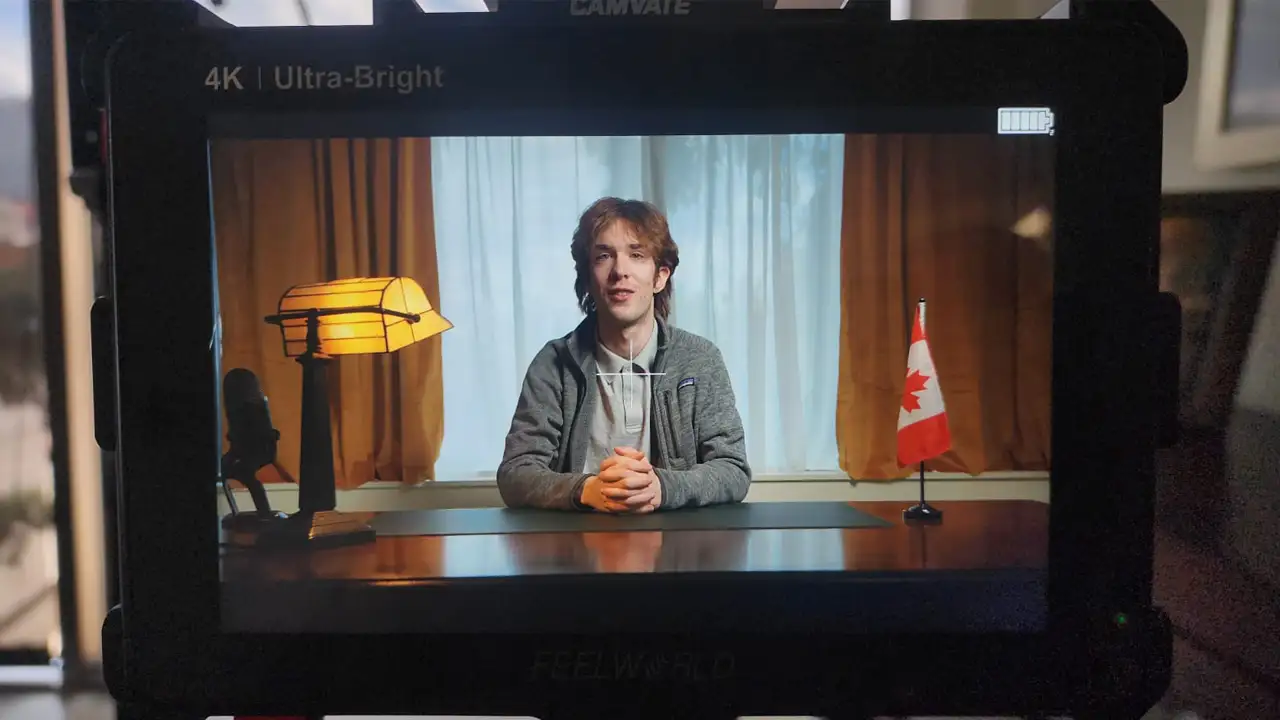
But none of that speed was luck. The groundwork was already in place. Several days earlier, I visited his office to run a lighting test while he was out, with a summer student standing in for him. When I was happy with the composition, staging, and lighting, I sent him a reference frame for approval. When the time came to capture his message, we weren't designing a shoot. We were running one.
That's the part of rapid-response video that gets the least attention and matters most: speed on the day is a function of decisions made earlier. Most advice focuses on the mechanics, efficient workflows, reusable assets, lean kits, and rightly so; they all help. But the real threat to a tight turnaround is never the mechanics. It's friction.
Friction is what slows you down
Friction is the drag between a comms team and a finished piece. It's the executive who hasn't read the script before walking on set. It's the stakeholder who hands over the brief on Friday afternoon and then goes quiet. It's handing off control of something critical, the audio capture, the lighting, the location access, to a party you haven't vetted. None of these things are about production. They're friction, and friction is what costs you the day.
The two biggest sources of friction I see, after twenty years of this work, are stakeholder availability and talent preparation.
When a comms team is fluid and responsive, answering questions quickly, agreeing on calls without long email chains, available in real time, projects move. When they're slow or unreachable, the production grinds. I ask at intake how we'll communicate during the project. Email certainly works, but it adds drag on a tight timeline. A WhatsApp thread or Slack channel keeps things moving in a way email doesn't.
The second source of friction is on the talent side. For scripted video segments, the single highest-value piece of preparation an executive can do is read their script out loud once, in the days leading up to the shoot. Not for performance but to verify that the words sound like them. If they do, the executive arrives already sounding like themselves. They nail it in the first or second take. They feel relaxed and confident, and the experience itself is a good one. If they haven't done that simple step, the session risks becoming a rewriting marathon. They second-guess the copy, hear themselves stumble, lose confidence with each take, and the comms person and I are watching a senior leader have a difficult hour on camera. It also adds significant time to a turnaround that was supposed to be short.
This is part of why I'm building PrompterPrep, a teleprompter app and practice simulator. It lets comms teams share scripts with their executives ahead of time, so they can rehearse on a screen that matches the real teleprompter they'll use on set. The platform is in development now and expected to roll out in the coming weeks. It exists because over the last twenty years, I've watched executives walk into shoots cold and struggle through an hour that preparation would have turned into fifteen easy minutes. Every bit of friction cleared in advance is time an executive gets back for the rest of their job.
What looks like a time-saver, and isn't
When time is at a premium, the tempting shortcuts aren't always the smart ones.
The first is replacing the human on camera with motion graphics alone. It's fast, it's controllable, and it avoids the logistics of an executive's schedule. It's also increasingly a problem. We're in a moment where AI-generated motion graphics content is flooding every feed, and audiences are growing fatigued by it. A recognizable, identifiable human on camera now does something it didn't have to do two years ago: it tells the viewer this is real. As AI avatars become more convincing, the credibility function of a face the audience already trusts becomes more valuable. Removing the human to save time often costs you the very thing that made the video worth making. Trust with your audience.
The second is overinvesting in production scale. I've watched four-person crews do work that one person with the right skill set could have handled just as well. Larger crews are justified for genuinely complex projects, but on rapid-response work they often add coordination overhead without adding value. The instinct to throw bodies at a tight deadline is rarely the answer it appears to be.
Stock footage is another one. It earns its place when there's something concrete to show. When the message is purely conceptual, it can get in the way. Corey's separatism piece would have been a different and weaker video with cutaways. Another rule: if using stock footage, commit to it throughout. A single stock clip dropped into an otherwise unbroken talking head highlights exactly where the time or budget ran out. Either use cutaways consistently or skip them.
A failure that became a discipline
Years ago, a colleague approached me to film his music performance at a pub in Inglewood. I had my audio recorder set to capture a feed from the house mixer. Levels checked clean at soundcheck, so I trusted the setup.
During the live show, the levels got pushed. My audio clipped throughout. There was nothing to salvage. I'll never forget sitting outside on my front steps the next morning, making that phone call. It was the defining low point in my career.
Since then, I've never trusted a house system that I didn't personally have control over.
A few years later, I was filming a live taping of The Strategist Podcast at a theatre in Calgary. The venue insisted they'd record the audio and hand it over. I pushed back, not aggressively, just by explaining that capturing my own backup feed was standard procedure on my projects because nothing is ever fully guaranteed. They accommodated me and at the end of the show, the venue's recording had failed entirely. The only usable audio was the backup I'd insisted on.
That was the first time Corey saw me work. The creative latitude he extends to me now, the trust that lets me make calls like no music, no cutaways, slow push-in without pushback, was earned in moments like that.
And on the topic of failure, at least once a year, I enter a 24 or 48-hour film race because it's both a lot of fun and the only environment where I can deliberately practice failure under time pressure. I push hard precisely to find my breaking points there rather than discover them on a client's project. So when something goes sideways on a shoot that counts, it's rarely the first time I've seen it.
When the turnaround is tight
Say your executive needs a video out by Monday. It's Friday afternoon. Here's where to start.
The first move is to get absolute clarity on the deadline and why it exists. Monday morning? End of business day? Ready for Tuesday morning? The why behind the deadline almost always shapes the message. What's driving the urgency tells you what the video actually needs to do.
The second is to confirm that all key stakeholders involved in the message's creation, review, and approval are available and responsive over the weekend. Set up a WhatsApp thread or a Slack channel. If a decision-maker plans to be unreachable, make note of it now and pivot accordingly, not at noon Saturday when you need their sign-off.
The third is to sketch out a rough production schedule and share it. It won't survive contact with reality, but it doesn't need to. The schedule's real job is to keep stakeholders accountable to their parts. A schedule everyone has seen is a contract everyone has implicitly accepted.
The one move I'd advise against is handing over the brief on Friday and then going quiet. That said, a good video strategist isn't sitting on their hands waiting for direction. I don't come at this purely as a camera operator. A business degree and twenty years across political, corporate, advocacy, and union comms mean I walk in already understanding the industry, the stakes, and what the organization is probably trying to do. When stakeholders can't be reached and deadlines are looming, I make the call I believe aligns with their interests and bring them a proposed solution rather than a question to answer. That's part of the job. But it works better, and faster, when we're doing it together.
What rapid-response work actually rewards
The videos that hold up under speed aren't the ones with the most production behind them. They're the ones where the friction was removed in advance, the creative call matched the moment, and the people involved trusted each other enough to make decisions quickly. Rapid-response work doesn't reward urgency. It rewards preparation, judgment, and the kind of professional relationships where the team behind the camera can anticipate what the team in front of it actually needs.
If you're a communications team that produces video regularly and want a partner who works this way, I'd be glad to talk, or email me directly at ryan@ryansauve.com. For the quickest reply, give Rocky a click/tap on the right.